 Skreen.ai
AI-Assisted Resume Screening Explained: What It Is (and What It Isn’t)
Few topics in recruitment generate as much confusion—or anxiety—as AI-assisted resume screening. For some, it conjures images of cold algorithms replacing human judgment. For others, it promises speed and objectivity. The reality sits somewhere in between, and understanding that distinction is essential.
Few topics in recruitment generate as much confusion—or anxiety—as AI-assisted resume screening. For some, it conjures images of cold algorithms replacing human judgment. For others, it promises speed and objectivity. The reality sits somewhere in between, and understanding that distinction is essential.
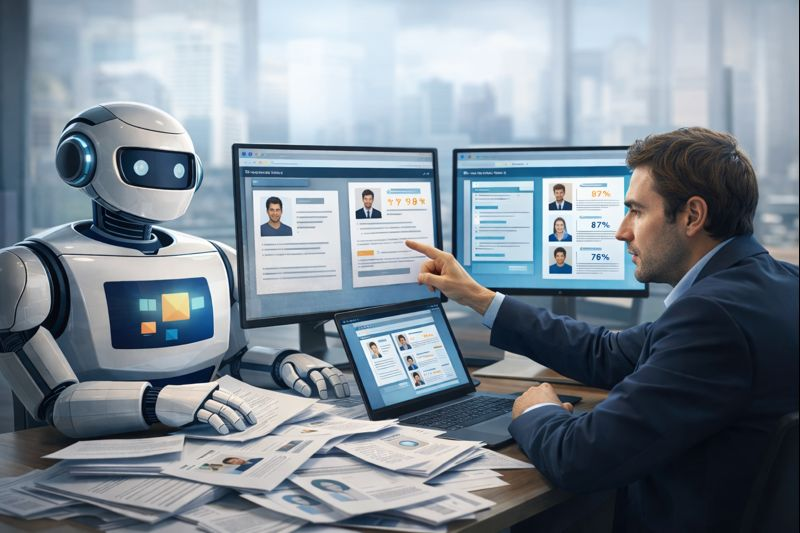
At its core, AI-assisted resume screening is about augmentation, not automation. These systems are designed to support recruiters by handling high-volume, repetitive tasks—not to replace human decision-making entirely.
Modern AI screening tools work by analyzing resumes and comparing them against job requirements. They extract structured data such as skills, experience, education, and career progression. Using machine learning and natural language processing (NLP), they interpret context, not just keywords.
This is a crucial distinction. Early screening software relied heavily on rigid keyword matching, often filtering out qualified candidates who used different terminology. Today’s AI can recognize that “Customer Success Manager” and “Client Relationship Lead” may represent equivalent roles, even if the exact words differ.
What AI does well is consistency and scale. It applies the same criteria to every resume, without fatigue or distraction. It can process thousands of applications in seconds, producing a ranked shortlist that reflects how closely each candidate aligns with the role.
What AI does not do—at least not well—is assess soft skills, motivation, or cultural nuance. It cannot read between the lines of an interview or sense a candidate’s values. These remain firmly human responsibilities.
Another common misconception is that AI makes hiring decisions autonomously. In reality, most systems provide recommendations, not final verdicts. Recruiters retain control, using AI outputs as a decision-support tool rather than a mandate.
It’s also important to address fears around fairness. AI does not magically eliminate bias. Algorithms trained on biased historical data can replicate and even amplify existing inequalities if left unchecked. Responsible AI use requires transparency, regular audits, and human oversight.
Used correctly, AI acts like a highly efficient research assistant. It surfaces relevant information quickly, flags strong matches, and ensures no candidate is dismissed due to oversight or exhaustion. It frees recruiters from mechanical filtering so they can focus on engagement, evaluation, and relationship-building.
The most successful hiring teams are not those that choose between humans and machines, but those that combine them intelligently. AI handles volume and pattern recognition. Humans handle judgment, empathy, and strategy.
AI-assisted screening is not about removing humanity from hiring. It’s about giving humans the time and space to apply it where it matters most.