 Skreen.ai
AI Will Reduce Hiring Bias and Improve Quality
Discover how AI-driven recruitment removes unconscious bias and shifts the focus to skills-based hiring to build diverse, high-performing teams for the future.
The traditional hiring process is, quite unexpectedly, one of the most flawed systems in modern business. Despite our best intentions, human decision-making is naturally prone to a phenomenon known as "cognitive load," which leads us to rely on shortcuts—or unconscious biases—to process information faster. These shortcuts often result in hiring managers favoring candidates who look like them, went to the same schools, or share similar hobbies, rather than those who are most qualified for the role.
The shift toward Artificial Intelligence (AI) in recruitment is often met with skepticism, yet it represents the most promising opportunity to bridge the gap between "gut feeling" and objective talent acquisition. When designed and deployed correctly, AI doesn't just speed up the hiring process; it actively deconstructs the barriers that keep diverse, high-quality talent out of the workforce. By transforming subjectivity into data-driven insight, AI is setting a new standard for quality and fairness in hiring.
The Hidden Cost of Unconscious Bias
Before we can understand how AI solves the problem, we must acknowledge the depth of the issue. Unconscious biases are automatic judgments we make about people based on factors like their name, appearance, accent, or educational pedigree. Because these biases are invisible to us, they are particularly dangerous. We often believe we are being objective when, in reality, we are falling for the "affinity bias" (favoring people similar to us) or the "halo effect" (letting one positive trait overshadow actual skill gaps).
Research consistently shows that identical resumes receive vastly different response rates based on the candidate’s name alone. This human error doesn't just hurt the candidates; it hurts the company. When bias dictates hiring, businesses miss out on top-tier talent, leading to higher turnover rates and a lack of cognitive diversity, which is essential for innovation.
How AI Redefines the Top of the Funnel
The first point of contact between a candidate and a company is the job description. Historically, these have been written with gendered language or "prestige" requirements that inadvertently discourage qualified applicants. This is where AI begins to level the playing field.
Neutralizing Job Descriptions
AI-driven text analysis tools can audit job postings in real-time. They identify "masculine-coded" words like competitive or ninja—which often discourage female applicants—and suggest inclusive alternatives like collaborative or dedicated. Furthermore, AI can help companies move away from arbitrary requirements, such as "Ivy League degrees," and refocus the language on core competencies and skills. This ensures the widest possible net is cast, attracting a truly diverse pool of applicants from the very start.
Objective Resume Screening
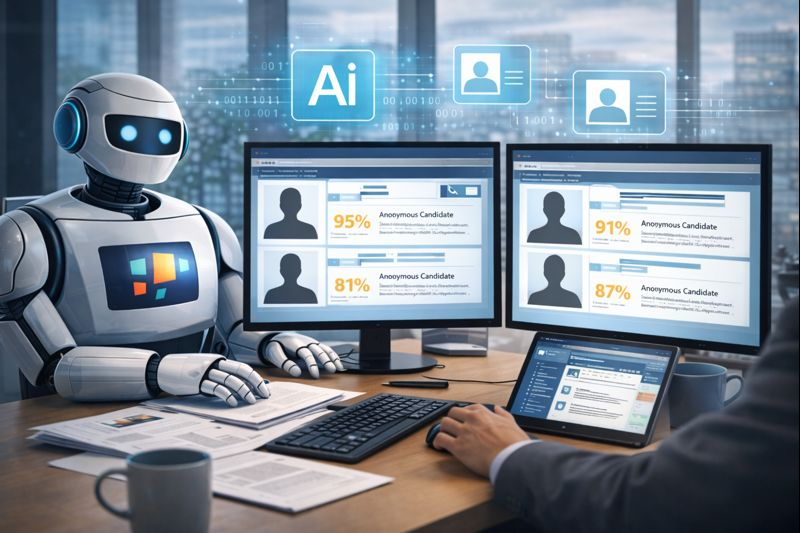
Traditional resume screening is where bias is most rampant. A recruiter might spend only six seconds looking at a CV, during which time their brain is scanning for familiar patterns (like a specific college or a previous employer). AI scoring algorithms, however, can be programmed to ignore demographic indicators entirely. By "masking" names, photos, zip codes, and graduation dates, AI forces the evaluation to stay focused on skills, certifications, and relevant experience.
Elevating Global Quality Through Skill-Based Assessment
The ultimate goal of any hiring process is to find the "best" candidate. However, humans are notoriously bad at predicting job performance based on an interview. AI improves the quality of hires by shifting the focus from pedigree to potential.
Automated Skills Testing
AI can facilitate blind work samples or "industrial-organizational" psychology-backed assessments. These tools measure a candidate’s cognitive ability, problem-solving skills, and personality traits in a controlled, objective environment. Because the AI evaluates the output of the test rather than the person performing it, the resulting data provides a much more accurate predictor of future job performance than a standard cover letter ever could.
Improving Structured Interviews
Even when humans enter the process for interviews, AI can act as a "bias-check" companion. AI tools can help managers build structured interview frameworks, ensuring every candidate is asked the same set of questions in the same order. Post-interview, some AI systems analyze the interview transcripts to identify if certain candidates were interrupted more often or if the interviewer spent more time talking about personal interests than job requirements. This feedback loop trains managers to become more aware of their own tendencies, improving the process for the long term.
The Ethics of AI: Avoiding the "Echo Chamber"
A common concern is that AI will simply automate human bias. If an algorithm is trained on a dataset of a company’s "top performers," and those performers are all of a similar demographic, the AI might conclude that those demographics are the key to success. This is known as algorithmic bias.
To ensure AI actually reduces bias rather than amplifying it, organizations must adopt a "Responsible AI" framework:
Regular Audits: Companies must regularly audit their AI tools to ensure they aren't producing disparate impacts on protected groups.
Data Transparency: Use "Explainable AI" (XAI) that shows why a candidate was ranked highly, allowing humans to verify that the criteria were relevant to the role.
Augmentation, Not Replacement: AI should be used to provide data-driven recommendations, but the final hiring decision should remain a human one—informed by the objective data the AI provided.
Building a Robust Hiring Panel with AI Data
Diversity in the hiring process is further supported when AI provides a "common language" for a hiring panel. When a diverse group of stakeholders meets to discuss a candidate, they often come with different subjective impressions. AI-generated reports provide a neutral third-party data set that the panel can use to ground their discussion. Instead of debating "culture fit" (which is often a proxy for bias), the panel can debate "culture add" based on the objective skill gaps identified by the AI.
Actionable Steps to Implement AI-Driven Hiring
If you are ready to use technology to build a more equitable and high-performing team, consider these five actionable steps:
Audit Your Current Language: Use AI writing assistants to remove gendered or exclusionary language from all external-facing job collateral.
Invest in Blind Screening: Implement software that strips demographic data from resumes before they reach human eyes.
Standardize with Data: Move away from "gut feel" interviews and use AI-backed scorecards tied to specific KPIs.
Prioritize Skills Over Schools: Use AI assessments to verify technical and soft skills, allowing candidates from non-traditional backgrounds to prove their worth.
Track Your Analytics: Regularly review hiring data to see if the diversity of your pipeline is improving and if your "AI-selected" hires are outperforming previous cohorts.
The Future of Equitable Hiring
Reducing bias is not a one-time project; it is a commitment to continuous improvement. While technology is not a "silver bullet," it is the most powerful tool we have to counteract the flaws in human cognition. By leveraging AI to focus on what truly matters—merit, skill, and potential—organizations can move past the limitations of the past and build the diverse, high-performing teams of the future.
The goal is simple: ensuring the right person gets the job for the right reasons. With AI as a partner, that goal is finally within reach.